A distinctive calcium borosilicate, rare in gem quality
Like the exceptionally rare gem-quality poudretteite, serendibite and grandidierite, danburite is a borosilicate. Its dense structure and high transparency give faceted stones a clear, crisp and often very bright lustre. Mineralogists have known the species since the nineteenth century, but large, coloured, well-cut specimens remain uncommon in high jewellery.
Colourless, pale yellow, golden yellow, light brown or, more rarely, pinkish, danburite has a different optical character from diamond. Its appeal rests on sufficient hardness to take a fine polish, low birefringence, high transparency and a cut that produces broad flashes of light.
The formula CaB₂Si₂O₈ combines calcium, boron, silicon and oxygen. Boron is crucial to the arrangement of the lattice and links danburite to a small group of boron-bearing minerals formed in specialised geochemical settings.
The species was described from crystals found in Danbury, Connecticut. Its name retains that geographical origin, although the type locality is no longer the main reference for the gem market. Mineralogical and commercial histories follow two paths here: the former establishes the species; the latter developed through transparent crystals from Mexico, Madagascar and other sources.
An orthorhombic borate framework
Danburite crystallises in the orthorhombic system. BO₄ and SiO₄ tetrahedra form a three-dimensional framework in which calcium occupies structural cavities. This architecture explains the mineral's compactness and some of the morphological relationships of its crystals.
The space group is often given as Pnam in the traditional mineralogical setting and Pnma in the standardised convention; both describe the same structural type with a different choice of axes.
| Reference framework | Classification |
|---|---|
| Formula | CaB₂Si₂O₈ |
| Family | Calcium borosilicate · borate-bearing tectosilicate |
| Crystal system | Orthorhombic |
| Crystal class | mmm · orthorhombic dipyramidal |
| Space group | Pnam / Pnma · no. 62 |
| Formula units | Z = 4 |
| Nickel–Strunz | 9.FA.65 |
| Dana | 56.3.1.1 |

Interactive structure with 360° rotation
Unit cell
Polyhedral coordination
Three stacked unit cells
Boron-bearing fluids, calcium-rich rocks and hydrothermal systems
Geochemical resources: mobile boron and calcium
Danburite formation requires two geochemical resources to meet: mobile boron, generally transported by fluids originating or remobilised near a magmatic system, and calcium available in the host rock or fluid. This convergence is localised. It explains why danburite is known in several geological settings without being a common mineral.
Contact deposits and metasomatic reactions
In contact metasomatic systems, a hot intrusion releases fluids that can circulate through limestone, dolostone or other calcium-rich rocks. Chemical exchange transforms the host rock: boron is introduced, while calcium, silicon and oxygen contribute to the formation of CaB₂Si₂O₈. Temperature, boron activity, the fluid–rock ratio and changes in pH determine whether danburite crystallises or other boron-bearing and calc-silicate phases are stabilised.
Granites, pegmatites and hydrothermal circulation
Danburite is also documented in granites, hydrothermal veins, fractures and certain specialised pegmatitic or pneumatolytic environments. Pegmatites concentrate incompatible elements, including boron, in the last magmatic melts. However, a boron-bearing pegmatite alone is not enough: calcium supply or availability and late fluid circulation remain decisive. A single region can therefore combine late magmatic crystallisation, hydrothermal alteration and metasomatic reactions.
Growth in cavities and evolving fluids
Cavities and open fractures favour euhedral crystal growth. Where space, fluid flow and cooling remain sufficiently stable, prisms can reach large dimensions. Conversely, rapid changes in pressure, temperature or composition can interrupt growth, trigger renewed growth, trap fluids or produce internal planes. These events preserve a three-dimensional record of the formation environment.
Mineral associations vary with the setting. Calcite, dolomite, quartz, albite and other feldspars may accompany danburite, as may titanite, grossular, axinite, tourmaline, datolite, fluorite or late hydrothermal minerals. An observed association provides environmental information but cannot, by itself, establish geographical origin.
Theoretical habits and crystal forms
Crystals are often prismatic along the c-axis, terminated by several sets of faces. Shorter, tabular, strongly striated habits and groups on matrix also occur. A complex termination can give a crystal a pseudo-tetragonal outline despite its orthorhombic system.

Theoretical crystal habits in 360° rotation
01 · Elongated prism
02 · Short prism
03 · Tabular form
04 · Complex termination
05 · Group on matrix
06 · Striated crystal
Interpretative models: they illustrate documented habits and do not represent the cut specimen.


Two specimens shown for comparison; these images do not document the same stone before and after cutting.
Physical and optical properties
| Property | Reference value |
|---|---|
| Refractive indices | Approximately 1,627–1,639 |
| Birefringence | Low, around 0,006 |
| Optic character and sign | Biaxial, negative in the Handbook of Mineralogy |
| 2V angle | Around 90° |
| Pleochroism | Absent to weak, depending on colour |
| Dispersion | Approximately 0,017 (NMNHS) |
| Specific gravity | Approximately 2,93 to 3,02 |
| Hardness | 7 to 7,5 Mohs |
| Cleavage / parting | Poor to imperfect, notably on {001} |
| Fracture / tenacity | Conchoidal to uneven · brittle |
| Lustre | Vitreous to slightly greasy |
Reference information for the species or published samples, rather than measurements of the Ultra Rare specimen. Sources: Handbook of Mineralogy ; NMNHS — Danburite.
Low birefringence limits visible doubling of facet edges. Moderate refractive indices produce a lighter lustre than in highly refractive gems. Cutting design is therefore essential: overly shallow pavilions create a window, whereas well-proportioned steps can redistribute light across a broad area.
Large stones require precise depth control. An overly broad table can reveal inclusions without bringing them to life; carefully calculated steps instead turn each plane into a mirror. Moderate specific gravity allows a high weight to occupy a substantial visible volume. This presence should not obscure fragility: hardness describes resistance to scratching, not impact.
Natural yellows and responses to ultraviolet light
Pure danburite tends towards colourlessness. Yellow, golden and light brown hues arise from structural defects, colour centres and small concentrations of trace elements. Their interpretation requires care: visually similar colours can result from different mechanisms.
Fluorescence varies considerably. Some danburites are inert; others show blue, greenish, yellowish or cream reactions depending on excitation, composition and lattice defects. A UV response is therefore neither a universal identifier nor proof of origin.

120-degree geometry and three-dimensional depth
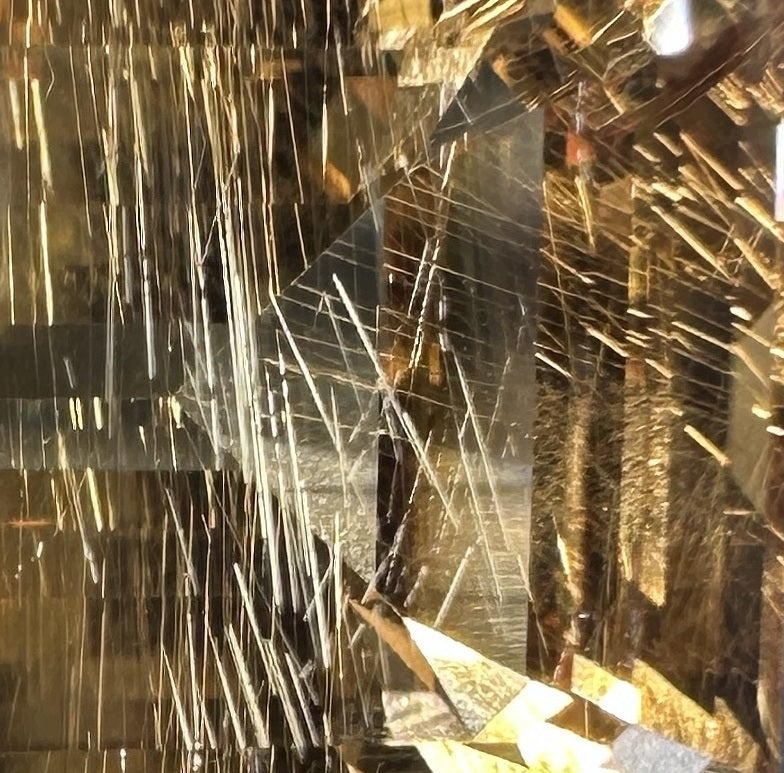
The 35.86 ct specimen displays angular internal features with several intersections developing at around 120 degrees. Depending on orientation, these form stars, interlocking triangles, Y-shaped lines and volumes that appear suspended within the stone. Rotation reveals that these patterns are not a surface design but an architecture distributed through its depth.
Parallel growth planes, healed fractures, fluid cavities and negative crystals can complete this internal landscape. Polishing and depth of field alter their visibility: a subtle face-up pattern may become spectacular when the viewing axis approaches its plane.
This scientific section gives the editorial name “Pluie d’étoiles” its meaning: it describes the impression created by real inclusion geometry observed in three dimensions, without replacing gemmological terminology.

Type locality and gem sources
Danburite was described at Danbury in Connecticut, the locality that gave it its name. Mexico, particularly Charcas in San Luis Potosí, has supplied notable transparent crystals. Occurrences are also known in Japan, Russia, Switzerland, Italy, Tanzania, Madagascar and several regions of the United States.
| Region | Published context |
|---|---|
| Danbury · United States | Historical type locality of the species. |
| Charcas · Mexico | Well-documented clear crystals and gem material. |
| Japan | Classic mineralogical localities, with crystals often on matrix. |
| Russia | Hydrothermal and metasomatic occurrences. |
| Tanzania | Occasional gem material. |
| Madagascar | Large transparent stones, sometimes yellow. |
Danburite · occurrence atlas
Map markers and interpretation
Mexico Source of transparent crystals and gem material.
United States · Danbury Type locality; its historical role does not describe current production.
Madagascar Several occurrences in central Madagascar; no specific mine is assigned to the specimen.
Russia · Japan Documented occurrences in distinct geological settings.
Tanzania · Myanmar Sources reported in mineralogical and gemmological literature.
Interpreting the blues and markers Dark blue: gemmological significance; medium blue: source; light blue: documented occurrence. Qualitative classification, without measured volumes. The markers do not locate every shaft.
Gem danburite and geological settings in central Madagascar
Madagascar holds a distinctive place in the history of collectible danburite. The country has yielded large transparent crystals and material capable of retaining, after cutting, a weight far greater than stones usually encountered on the market. Rarity is therefore not simply that of the species: it arises from the convergence of rough size, transparency, colour, integrity and cutting yield.
Mineralogical references document several Malagasy occurrences, notably Anjanabonoina, Maharitra in the Mount Bity region, Imalo south of the Betafo district and Sahasonjo north-east of Andina. This diversity prevents all Malagasy danburite from being equated with a single deposit. It also reminds us that “Madagascar” on a gemmological report identifies a country of origin, not a specific mine or pocket unless the laboratory explicitly states otherwise.
Central Madagascar brings together ancient metamorphic terrains, intrusions and numerous pegmatite bodies. In these evolved systems, boron can become concentrated in the last magmatic melts and then be transferred by late fluids. Danburite also requires sufficient calcium availability. Interfaces between granitic or pegmatitic bodies, calcium-rich host rocks, fractures and hydrothermal circulation thus provide favourable environments, without imposing a single model on every occurrence.
Three stages should be distinguished. Boron concentration first prepares the system. Fluid–rock reactions and metasomatism then allow boron, calcium and silicon to combine. Finally, fractures or cavities opening up provide the space for euhedral prisms to grow. Variations in pressure, temperature or fluid composition may leave zoning, renewed growth, healed fractures and fluid inclusions within the crystal.
After crystallisation, exhumation and weathering of the host rocks can release crystals. Secondary transport may round some surfaces or separate gem material from its matrix. For this reason, a crystal's appearance or the inclusions in a cut stone cannot alone reconstruct its entire geological history or identify a precise locality.
For the 35.86 ct “Pluie d’étoiles” specimen in the Ultra Rare Gemstone collection, Madagascar origin and the absence of indications of treatment are linked to Laboratoire Français de Gemmologie report no. 406349. The article maintains a methodological distinction between these specimen-specific conclusions, published occurrences of the species and general geological models.
Madagascar · geology and documented areas
Right: enlargement of the central and southern areas from the same reference base map. The named markers on the left remain indicative; halos are not cadastral boundaries.
Location key
Anjanabonoina Pegmatite · gem crystals.
Ibity · Maharitra Documented occurrence · Mount Ibity area.
Geological background and symbols Colours distinguish basement domains, sedimentary cover and volcanism. Triangles: primary deposits; halos: documented areas. Boundaries are generalised.
Sources: Handbook of Mineralogy · Danburite ; Dirlam et al. · Anjanabonoina, GIA, 2002 ; Tucker et al. · Synthesis of the Precambrian basement .
Detection and disclosure
Danburite is not associated with a treatment industry as structured as that for corundum. Examination nevertheless looks for fracture filling, surface residues, colour modifications and indications of heating or irradiation.
LFG report 406349 records the conclusion “N”, meaning no indication of treatment under the laboratory's nomenclature. The commercial product page reproduces this conclusion without extending it to the species as a whole.
Rarity within rarity
Occurrence
The presence of danburite in a deposit does not by itself indicate how much gem-quality material is available. Localities and their geological settings appear in the article’s atlas. Hue, transparency, the volume retained after cutting and the arrangement of inclusions then determine the specimen’s appeal.
Rarity of gem quality
- Colour: clearly expressed, even and sufficiently bright pink or golden yellow.
- Transparency: the ability to see into the stone despite its internal structures.
- Cut: step proportions, symmetry and control of windowing.
- Weight: retaining substantial weight after cutting without major loss of light.
- Inclusions: aesthetic coherence and three-dimensional visibility.
- Documentation: identity, origin and treatment status linked to the report.
At 35.86 ct, the specimen belongs to a category of exceptional presence. Its interest does not depend on absolute clarity: structured internal features are part of its identity and transform the stone into an optical landscape.
Distinguishing danburite from pale gems
The combination of refractive indices, specific gravity close to 3,0, biaxial character, low birefringence and spectrum distinguishes danburite from quartz, topaz, beryl, certain feldspars and glass.
Topaz has a higher specific gravity than danburite and perfect basal cleavage. Its refractive indices are not systematically higher: the ranges of the two species overlap, and some topazes have lower indices. Quartz has markedly lower indices and uniaxial character. Raman spectroscopy provides robust confirmation of danburite when conventional instruments leave ambiguity.
Two perspectives on a weakly absorbing material
Visible spectra of colourless danburite may show few features, with more pronounced absorption where colour centres or trace elements produce a yellow hue. UV-Vis-NIR describes colour; Raman identifies the framework; photoluminescence can document certain active centres.
The profile below is a qualitative visualisation linking absorption and transmitted colour. It is not a measurement of the specimen named “Pluie d’étoiles” by Ultra Rare Gemstone.

Examining the “Pluie d’étoiles” danburite
The stone is a natural transparent danburite from Madagascar. LFG report 406349, dated 14 December 2023, links its identity to its dimensions and records no indication of treatment.
Face up, the steps frame a broad, bright table. The profile reveals a deep pavilion. In rotation, geometric inclusions at 120 degrees cross several planes, creating real visual depth. This is precisely where the name “Pluie d’étoiles” faithfully describes the experience of the specimen.
Actual photograph
“Pluie d’étoiles” · 35.86 ct
The photograph connects the encyclopaedic content with the collector's stone. Macro, profile, rotation and UV media complete the examination.
2.3 ct orangy yellow danburite, elongated octagonal cut · 1.9 ct golden yellow danburite, cushion cut · Explore the danburite collection
Methodological note
The article distinguishes general danburite properties, educational visualisations and observations of the specimen. The habits and inclusion atlas are interpretative; the macro, UV and face-up views are real. The spectral profile is documentary and was not measured on the 35.86 ct “Pluie d’étoiles” specimen.
Conclusion
Danburite combines a precise borate framework with understated luminosity. In the specimen named “Pluie d’étoiles” by Ultra Rare Gemstone, substantial weight and a step cut provide room for the inclusions to form a three-dimensional architecture. Science describes the planes, cavities and angles; the collector experiences the way they shape the light.
Main sources and further reading
- Handbook of Mineralogy — Danburite
- RRUFF — Danburite
- American Mineralogist — structural studies of danburite.
- Gem-A — gemmological documentation
- Mindat — mineralogical data and danburite localities.
- Laboratoire Français de Gemmologie report 406349 · 14 December 2023.
- Handbook of Mineralogy — Topaz
Gemmological examination protocol
Identification of a large yellow stone should follow a sequence. Unaided observation precedes the polariscope, refractometer and hydrostatic weighing; microscopy then examines the continuity of planes, cavity shapes and possible filling residues. Spectroscopic methods confirm the species or document the colour. No single clue — hue, fluorescence or inclusion pattern — replaces this combined evidence.