Ultra Rare Gemstone · Science – Gemmology
Morganite
Pink within the architecture of beryl
Morganite's pink is understood through beryl's structure, its colouring elements and its growth conditions. This article connects properties, inclusions, deposits and identification methods with photographs from the collection.
One variety, one architecture, one colour
Morganite is the pink to orangey pink variety of beryl. Its reference formula, Be₃Al₂Si₆O₁₈, describes a framework of beryllium, aluminium, silicon and oxygen. Manganese, present in small quantities, introduces the selective absorption that creates colour. A minute chemical substitution can thus transform the appearance of an entire crystal: the material retains beryl's architecture, but the light passing through it emerges with a different distribution of wavelengths.
Morganite, aquamarine and emerald therefore belong to the same mineral species. These names do not denote three independent crystal architectures: they distinguish colour expressions associated with trace elements and their lattice environments. This relationship explains their shared properties; it does not make their deposits, inclusions or treatments interchangeable.
Morganite's pink may remain very light, take on a peach shade or approach a stronger pink. Its appearance also depends on the thickness traversed and the orientation. A pale gem is not necessarily lacking in interest: when clear and well cut, it reveals the geometry of light with great precision. Scientific identification establishes the nature of the material; jewellery selection then considers the harmony of colour, clarity, proportions and movement.
Silicate rings and structural channels
Beryl is a hexagonal cyclosilicate. Its reference space group is P6/mcc, number 192; its Bravais lattice is primitive hexagonal. In an ideal description, the unit cell contains two formula units. The characteristic motif is a ring of six SiO₄ tetrahedra. Each tetrahedron shares oxygen atoms with its neighbours, creating an Si₆O₁₈ loop rather than an infinite chain of tetrahedra.
These rings stack along the crystallographic c axis. BeO₄ tetrahedra and AlO₆ octahedra link the silicate units. The framework leaves channels parallel to c that can accommodate water and alkalis, among other constituents. These are not visible cavities or fissures: the spaces belong to the crystal's atomic organisation. Their occupancy contributes to the chemistry of actual beryls and their spectroscopic response.
The ideal formula describes the major constituents; it does not encompass every possible substitution. Charge compensation allows incorporation of cations different from the ideal constituents. Structural analysis then connects composition, site occupancy and unit-cell parameters. Values from a published crystallographic model concern the sample studied by its authors, while the general architecture provides a reference for understanding the species.
Three scales illuminate beryl's structure: the unit cell expresses repetition of the motif, polyhedra describe atoms' immediate neighbours, and stacking reveals the continuity of channels along the c axis. Rotation makes these spatial relationships easier to follow.
This internal symmetry explains the possibility of a hexagonal outline in rough crystals. It does not prescribe the gem's cut: a rectangular or oval morganite remains crystallographically hexagonal. The lapidary shapes an external envelope without changing the crystal system.
Crystal structure in 360° rotation
01 · Unit cell — Beryl
02 · Coordination AlO₆
03 · Three unit cells along c
Reference: Hazen, Au and Finger (1986), AMCSD 1040. Hexagonal unit cell P6/mcc: a = 9,208 Å; c = 9,188 Å; Z = 2. The spheres identify the elements without showing their ionic radii to scale. The segments connect the nearest Be–O, Al–O and Si–O neighbours calculated for this structure; the grey frame outlines the unit cell. Bonds extending beyond the volume shown are truncated. The views describe a reference structure for beryl. Reference publication and data .
Six crystal architectures of beryl
Prisms, basal faces and terminations combine into six distinct geometries. These reconstructions show combinations of faces documented for the mineral species beryl; their illustrative proportions do not describe the original rough of the gem presented here.
01 · Prism and basal face

{10−10} · {0001}
8 faces · 12 vertices
02 · Two combined prisms

{10−10} · {11−20} · {0001}
14 faces · 24 vertices
03 · Pyramidal termination p

{10−10} · {0001} · {10−11}
20 faces · 24 vertices
04 · Pyramidal termination s

{10−10} · {0001} · {11−21}
20 faces · 36 vertices
05 · Two combined pyramids

{10−10} · {0001} · {10−11} · {11−21}
32 faces · 60 vertices
06 · Combination of five forms

{10−10} · {11−20} · {0001} · {10−11} · {11−21}
38 faces · 72 vertices
Indices in braces denote families of equivalent faces. Inclinations are calculated using beryl's hexagonal metric (a = 9,208 Å; c = 9,188 Å). Surface relief and lighting are illustrative. The colour evokes the variety; this is not a photograph.
Sources and construction of crystal habits
Forms {0001}, {10−10}, {11−20}, {10−11} and {11−21}: morphological study of beryl, Gems & Gemology, Winter 1984, p. 213 . For relationships between faces, growth and dissolution in emerald: Schmetzer and Martayan, 2023 . The six combinations are educational constructions of these families, with no attribution to a mine or assumed frequency for the variety.
The final chapter of a granitic system
Morganite is associated with granitic pegmatites. These rocks can contain remarkably large crystals, but their significance cannot be reduced to slow, uniform growth. Residual melt composition, volatile content, degree of undercooling, nucleation and material transfer together control texture. Large crystals can grow because few nuclei develop in an environment able to supply their growth efficiently.
As magma crystallises, minerals already formed take up certain elements. Others preferentially remain in the liquid fraction. Beryllium can therefore become enriched in the late stages of some granitic systems. When composition and stability conditions become favourable, beryl can crystallise with quartz, feldspars and micas. Beryllium is necessary but insufficient to produce gem-quality morganite: the chemistry responsible for colour and a usable crystal volume are also required.
A pegmatite may display successive zones, replacement assemblages and pockets. Crystals embedded in a rock mass do not have the same growth space as those developing in a cavity. A pocket may allow better-defined faces, but does not guarantee transparency. Compositional changes, renewed growth, solid or fluid inclusions and later stresses can interrupt the crystal's optical continuity.
The transition from a magmatic environment to late fluids introduces another dimension. Fluids can circulate, dissolve some phases and deposit others. The observed mineral sequence is then a history, not simply a list of minerals present simultaneously. To reconstruct it, geologists examine contacts, cross-cutting relationships, zoning and inclusions: a crystal enclosed within another, a replacement rim and a late fracture provide different chronological information.
Manganese must be available in a form compatible with incorporation and with the centres responsible for colour. Its total abundance alone does not predict an attractive pink. Iron, valence states, defects and elemental distribution contribute to the optical response. Two beryls from the same system may therefore differ greatly in colour and transparency.
Crystal habits also illustrate competition between growth directions. A long prism, a stout crystal, a tabular form and a partially dissolved crystal may belong to the same species. The faces expressed result from relative growth or dissolution rates. Habit models are geometric tools: they show morphological possibilities without replacing photographs of documented rough.
The lapidary works at the end of this sequence. Fractures, colour zones and directions of light transmission are examined before a usable volume is chosen. Losing weight can substantially improve the result if it removes a scattering zone or protects a vulnerable corner. The final gem therefore concentrates only part of the rough's history: its shape brings out the retained material, while field records illuminate what cutting removed.
What the gemmologist measures
Species: Beryl · Ideal formula: Be₃Al₂Si₆O₁₈ · System: Hexagonal
| Refractive indices | 1,583 to 1,590 |
|---|---|
| Birefringence | 0,007 to 0,008 |
| Optic character and sign | Uniaxial negative |
| 2V angle | Not applicable in the ideal uniaxial state |
| Pleochroism | Dichroism varies with composition and orientation |
| Dispersion | Low, approximately 0,014 (beryl, NMNHS) |
| Specific gravity | 2,80 to 2,91 |
| Hardness | 7,5 to 8 Mohs |
| Cleavage / parting | Imperfect on {0001} |
| Fracture / tenacity | Conchoidal to uneven · brittle |
| Lustre | Vitreous |
Reference information for the species or published samples, rather than measurements of the Ultra Rare specimen. Sources: Handbook of Mineralogy ; NMNHS — Beryl .
Beryl's hardness generally lies between 7,5 and 8 on the Mohs scale. This property describes scratch resistance, not impact resistance. Like any gem, morganite has more exposed areas depending on its cut: tips, edges and corners may require particular protection in a setting.
Beryl is optically uniaxial negative. In general directions, light is described by an ordinary and an extraordinary ray, with different refractive indices. Birefringence is the difference between the principal indices. A refractometer used on a suitable facet allows their limits to be sought and the results compared with the stone's proposed identity.
Refractive indices and specific gravity vary with composition. Alkali-rich beryls can differ from compositions close to the ideal end member. A reference range guides identification; the value for an individual gem must come from measurement. Refractometer readings thus complement the description of colour, cut and transparency.
A faceted stone's brilliance also depends on geometry. Well-polished facets give sharp reflections; their orientation determines internal light paths. A window allows the background to be seen through some areas, while extinction refers to temporarily dark areas in a particular position. Rotation helps assess these phenomena without confusing a single photographic moment with the gem's overall behaviour.
Manganese within a beryl lattice
Explaining colour begins with a distinction: a chemical element is not a colour. Manganese can occupy different environments and valence states. The available electronic transitions depend on that environment. The element must therefore be connected to its site, valence and spectrum rather than automatically assigning a single ion to all morganites.
Research on pink beryl discusses, among other factors, the roles of Mn²⁺ and Mn³⁺. In a Madagascan example studied by LFG and published in 2024, broad absorption near 567 nm is attributed to Mn³⁺ in beryl. This observation provides a documentary reference for the pink component; it is not the spectrum of the 3.08 carat morganite presented by Ultra Rare .
Perception results from all the remaining light, not simply the position of one band. A peach shade combines pink with a warmer component. The illuminant changes their apparent balance: daylight, LED and incandescent lighting provide different spectral distributions. White balance and the display then influence photographic reproduction.
Optical path length also matters. The same material often appears more coloured when light passes through greater thickness. This relationship explains why volume and cut affect the presence of a delicate pink. It does not justify digital colour modification: photography should show the specimen under the stated conditions, and video should reveal its actual variations.
Reading growth without confusing specimens
Inclusions record different episodes in a crystal's life. Some solid phases were enclosed during growth. Cavities trapped fluid that may later separate into several phases on cooling. Fractures may form later and partially heal. Microscopy distinguishes their shapes, distribution and relationships with growth zones.
An alignment of inclusions may mark an earlier growth surface; a group crossing several zones may represent a later event. A cavity elongated along a crystallographic direction should not be identified from its outline alone. Morphology provides a clue, while spectroscopy can clarify the nature of an accessible solid inclusion.
The 2024 LFG study describes small yellow helvine inclusions and dark hübnerite crystals, identified by Raman spectroscopy, in another Madagascan morganite. This example shows how a mineral association illuminates the chemistry of the growth environment. It does not imply that those inclusions occur in the Ultra Rare stone, selected here for its eye clean VVS clarity.
‘Eye clean’ describes unaided-eye observation under normal conditions. It does not mean the absence of every internal feature at every magnification. Transparency plays a particularly visible role in a step cut: the large facets offer a direct view into the material and make precise polishing important. Close-up photography and loupe examination complement this initial view without replacing it with an artificially clarified image.

Deposits - Atlas
Documented morganite sources include Brazil, Madagascar, Afghanistan, Mozambique, Namibia and the United States. Brazil, particularly Minas Gerais, plays an important role in production. Madagascar is especially significant in the history of the variety and its colours.
A mineralogical occurrence does not necessarily correspond to regular gem production. Discovering a pink crystal in a pegmatite measures neither usable volume nor the transparent proportion or continuity of supply. Pockets are discontinuous: an exceptional discovery may remain an isolated event.
Worldwide deposit distribution mainly illustrates the presence of favourable geological settings. For an individual stone, provenance requires a documentary chain. A country of origin alone cannot identify a mine. The atlas presents key districts for the variety; the specimen's page states its own provenance.
Deposits – Atlas
Location key
Documented sources Brazil, Madagascar, Afghanistan, Mozambique, Namibia, United States.
Madagascar Pink beryl-bearing pegmatites; districts detailed in the following section.
Read the map information
Brazil, Madagascar, Afghanistan, Mozambique, Namibia, United States.
A selection of documented localities; not exhaustive. Base map: Natural Earth, public domain. View the reference source .
Ancient basement, pegmatites and beryl diversity
Madagascar has a complex crystalline basement comprising domains that underwent several episodes of formation, deformation and metamorphism. Granites and their pegmatitic systems belong to this history. Its gems therefore do not come from a single layer or island-wide event: each district must be understood through its host rocks, intrusions and structures.
For morganite, pegmatites in the centre of the island are an important reference. Anjanabonoina, in the Betafo region, is known for its mineral diversity. Studies of tourmalines from the area also describe morganite among the associated gems. This association is geologically significant: pink beryl belongs to a system where several scarce elements can concentrate and contribute to a complex mineral sequence.
Today's landscape must be distinguished from the crystallisation setting. Pegmatites formed at depth; mining landscapes later resulted from uplift, erosion and weathering. Under a tropical climate, feldspars and other host-rock minerals may become deeply weathered. Resistant crystals are then released from their matrix and may subsequently move downslope or through river systems.
This evolution changes discovery conditions. In primary mining, the crystal's relationships with its pocket and neighbouring minerals can be observed. In a reworked deposit, some of these relationships are lost. A rounded, fractured or isolated crystal may record transport or weathering; its shape alone cannot reconstruct a precise origin. Field documentation retains a value that examination of a cut gem cannot entirely replace.
The diversity of Madagascan beryls also reflects chemical differences. Aquamarine and morganite share an architecture but not necessarily the same growth episode or distribution of chromophores. A local environmental change may favour another shade or variety. Trade names describe colour; deposit studies investigate the processes that made it possible.
Madagascar's relief, major geographical features and pegmatite districts illuminate pink beryl formation. Anjanabonoina serves here as a geological reference; the 3.08 carat morganite belongs to Ultra Rare's Madagascar selection.
This distinction allows a precise account: geological history explains the conditions that make the gem possible, while the individual dossier preserves the piece's own data. The two levels reinforce each other when clearly connected. They lose clarity when a general atlas is implicitly treated as proof of every specimen's origin.
Regional interpretation also benefits from examining neighbouring minerals. An assemblage of quartz, feldspars, micas and accessory minerals can help identify a stage in pegmatitic evolution. Growth relationships are more precise than a simple association in the same sale lot: they reveal which minerals actually touch, cut across or replace one another. At this scale, Madagascar's mineral diversity becomes a history of processes, not merely an inventory of colours.
Madagascar · geology and documented areas
Enlargement of the national base map · Central Madagascar, without mining boundaries.
Location key
Read the map reference points and sources
Pink beryl from evolved pegmatites. At Anjanabonoina, morganite occurs with feldspars, quartz and tourmalines, among other minerals.
- Anjanabonoina — Pegmatite · gem morganite.
- Tsaramanga · Mahaiza — Historical production · of pink beryl.
The base map distinguishes the six major basement domains, sedimentary cover, Isalo and volcanic terrains. Boundaries are generalised; halos denote geographical areas. Documented localities do not imply current activity.
Sources: Dirlam et al. · Anjanabonoina, GIA, 2002 ; Isatelle · Tsaramanga, GIA, 2010 ; Tucker et al. · Synthesis of the Precambrian basement .
Understanding practices associated with the variety
Heating is known in the morganite trade as a way to alter colour balance, particularly by reducing certain yellow or orange components. Its effect depends on the starting material and its colour centres. It does not turn beryl into another species; it changes the response of certain centres within its lattice.
The heat treatment commonly used to reduce yellow or orange components in morganite can be undetectable by routine gemmological examination. Although heating may affect some inclusions or fractures, the absence of such signs does not establish that a stone is unheated. A gemmological report states the findings and conclusions supported by the methods used; it does not guarantee that the stone’s thermal history can be reconstructed. Any statement that a morganite is unheated must therefore distinguish supply-chain documentation from what laboratory analysis can establish. When a report exists, its exact conclusion is retained in the specimen’s dossier.
Irradiation is also studied in pink beryls. It can modify electronic defects and colour centres. Treatment research distinguishes the colour obtained immediately, its stability under light or heat, and any associated analytical signatures. Results published for an experimental batch should not be generalised to all stones without considering composition and experimental conditions.
Before-and-after comparison is meaningful only for the same material photographed under a consistent protocol. Observation then follows changes in hue, saturation and absorption bands. It connects visible changes with transformations of colour centres within the crystal.
Treatment, cutting and care must also be distinguished. Cutting and polishing determine the presentation shape; in this context they are not colour or clarity treatments. Routine cleaning removes surface dirt. Fracture filling, coating or deliberate modification of colour centres belongs to a different category and requires appropriate disclosure.
Ultra Rare Gemstone selects natural, unheated and untreated gems. The 3.08 carat morganite is offered within this framework. Presenting practices known for the variety explains the science and the market; it does not attribute those practices to the specimen. Testing or a gemmological report may be requested according to the services listed on its product page.
Assessing a combination rather than an isolated figure
Occurrence
Occurrences presented in the atlas include Brazil, Madagascar, Afghanistan, Mozambique, Namibia and the United States. A mineralogical occurrence measures neither transparent material production nor the availability of a particular pinkish peach shade and clarity.
Rarity of gem quality
Morganite rarity must be considered at several levels. First comes a geological setting capable of producing pink beryl. Next is the volume of transparent, usable material. Then comes the combination of colour, clarity, integrity and dimensions. Finally, cutting transforms rough into an object whose visual balance depends on precise choices.
Large morganite crystals exist, so weight alone is not a universal indicator of exceptional quality. Conversely, a smaller stone may offer a compelling combination of hue, clarity and proportions. Comparing two gems requires clarity about what is being compared: rough weights, cut stones, colour quality, treatment, documented origin or the commercial rarity of a particular size.
The 3.08 carat morganite illustrates a selection based on a balance of qualities. Its pinkish peach shade, eye clean VVS clarity and elongated silhouette give it a soft yet well-defined character. Its appeal in a jewellery design lies in the particular qualities of the gemstone and a cut that reveals them, rather than a claim to a record.
A numerical rarity comparison with diamond would require a defined population, period and comparable counting method. Without them, a multiplier creates an impression of precision without describing a measurement. This assessment remains based on observable criteria and the individuality of the piece.
Combining methods
Examination begins with observation: colour, transparency, surface condition, shape and internal features. Measurements compatible with the stone's setting or condition follow. Refractive indices, birefringence, optical character and, where possible, specific gravity help identify beryl.
Microscopy looks for consistency between growth structures and inclusions. A very clear gem offers fewer immediately visible features, making other methods all the more important. A single property should not carry the whole identification when it may be shared by several materials.
Raman spectroscopy provides information about vibrational structure and can identify inclusions. Infrared spectroscopy investigates components associated with water in the channels, among other features. UV–visible–near-infrared absorption contributes to studying colour centres. Chemical analyses establish major and trace elements according to the method and its detection limits.
The report should distinguish three questions: what the material is; what is observed about its condition or treatments; and what evidence supports its origin. Answering the first does not automatically answer the other two. The quality of the dossier comes as much from organising the evidence as from the number of instruments used.
From manganese to pink colour
An absorption spectrum relates a measured quantity to wavelength. Its shape depends on the material, orientation, thickness traversed and protocol. Comparing curves requires explicit axes, units and normalisation methods. A normalised curve highlights relative shapes; it does not necessarily preserve concentration or absolute intensity information.
In the visible range, manganese-related absorption contributes to pink colour. The example published in 2024 provides a reference for a broad band around 567 nm. Iron and water contributions are also described in that sample's near infrared. These components must be distinguished from those of its inclusions: the spectrum of a complex volume may superimpose several signatures.
Raman and infrared spectra are usually read in wavenumbers, expressed in cm⁻¹, rather than on the same axis as visible wavelengths in nanometres. These methods complement visible absorption: Raman characterises lattice vibrations, while infrared spectroscopy provides information about molecules in the channels, among other constituents. The figure below presents literature-based reference points for visible absorption in pink beryl.

Interpreting the colour. Manganese absorbs part of the green-yellow light; the remaining red and blue components contribute to pink.
Published reference points. ≈ 567 nm · Mn³⁺. Band of the beryl matrix; lines from helvine inclusions are excluded. Fritsch et al., G&G, 2024 .
Graph conventions. Band positions are taken from the literature. Widths and amplitudes were chosen for this explanatory diagram; transmission is calculated from this illustrative absorption, without reflection or scattering. The curves do not reproduce a laboratory recording.
Three complementary approaches. Raman spectroscopy measures a frequency shift in scattered light associated with vibrations; FTIR measures infrared absorption; photoluminescence examines light emitted after excitation. These signals differ from the visible absorption shown here.
Pure, rosy softness
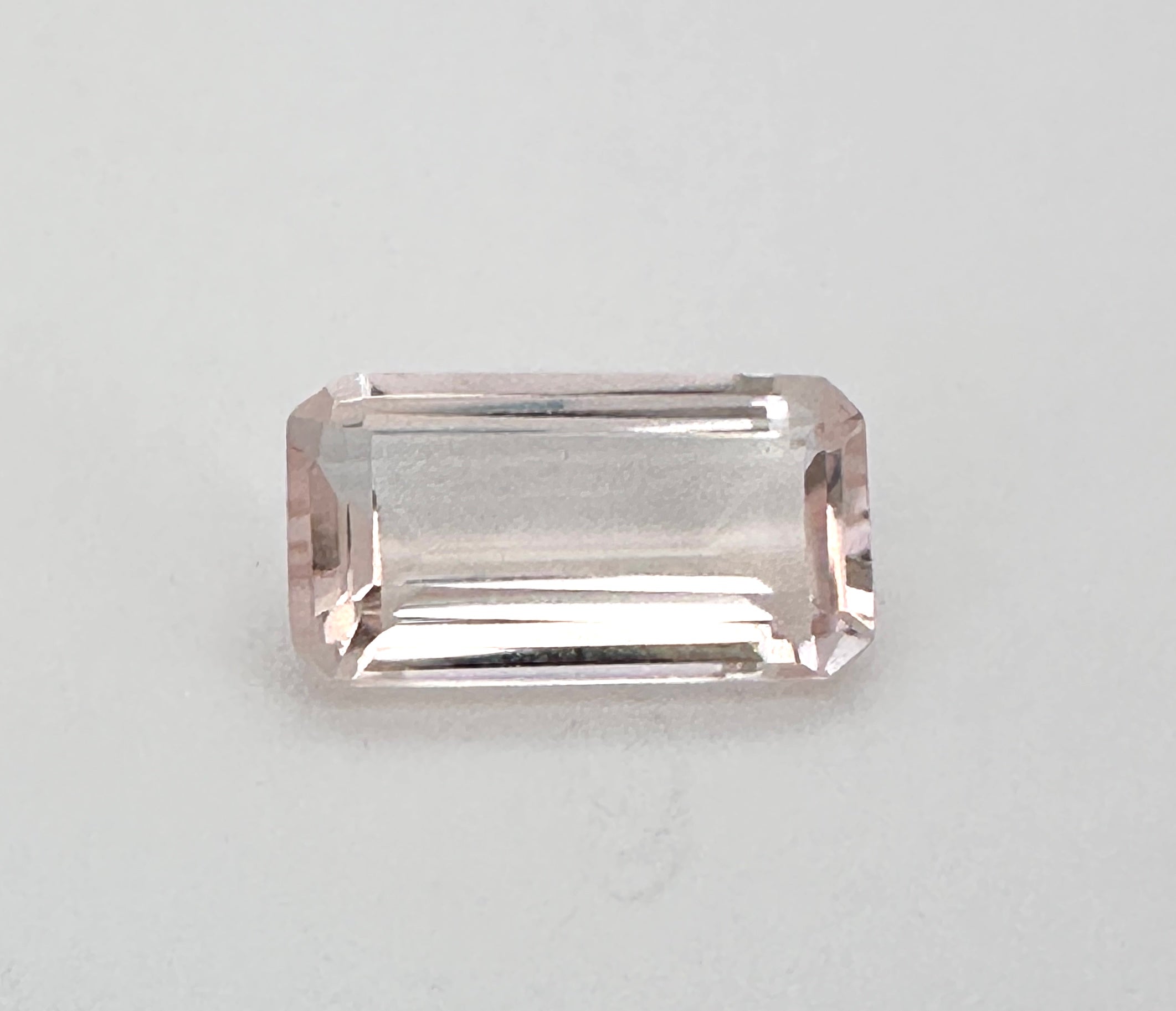
The piece in the collection is a peach-pink morganite from Madagascar weighing 3.08 carats, with eye clean VVS clarity. Its stated dimensions are 12.5 × 6.8 × 4.4 mm. The rectangular cut-corner shape and step cut offer an elongated silhouette. Large facets reveal transparency across the stone and display its pinkish shade without dispersing it through an excessively fragmented design.
The photographs and video show the actual stone. Rotation reveals moving reflections, while still views clarify proportions and angles. Media cleaning preserves the gem's colour, clarity and lustre; it removes no internal feature to improve its presentation artificially.
Ultra Rare offers it as natural, unheated and untreated. Ultra Rare has examined its optical and physical characteristics. The stated documentation options are testing at 50 € and a Bellerophon GemLab report at 150 €. The ‘Contact us’ button on the product page can be used to request these services. These services do not guarantee that all prior heating can be ruled out: the heat treatment commonly used for morganite can be undetectable. The general properties discussed in this article explain the variety; the commercial dossier retains the characteristics and documents specific to this piece.
Method, care and references
Assessing a gem benefits from a consistent sequence: identify the material, observe the media, examine documents, then consider cut and colour. When comparing photographs, favour consistent lighting and backgrounds. For spectra, examine units and measurement conditions. For origins, return to each stone's documentation.
Clean morganite with lukewarm water, mild soap and a soft brush, then rinse carefully. Before cleaning a mounted stone, check that it is secure in its setting. Avoid impacts to edges and sudden temperature changes. A jewel designed around an elongated cut can protect its ends while allowing light to reach the gem.
The references below document the species' properties and the scientific examples cited. The Ultra Rare dossier, meanwhile, brings together data and photographs for the 3.08 carat morganite.
- GIA, Morganite and Morganite Description : https://www.gia.edu/morganite ; https://www.gia.edu/morganite-description
- Hazen, Au and Finger (1986), High-pressure crystal chemistry of beryl and euclase , American Mineralogist 71, 977–984; reference structure listed by AFLOW: https://aflowlib.duke.edu/p/52T5/
- Shigley (1984), Gem-Bearing Pegmatites: A Review , Gems & Gemology: https://www.gia.edu/gems-gemology/summer-1984-pegmatite-shigley
- Liddicoatite Tourmaline from Anjanabonoina, Madagascar , Gems & Gemology, Spring 2002: https://www.gia.edu/doc/Spring-2002-Gems-Gemology-Liddicoatite-Tourmaline-Madagascar.pdf
- Fritsch, Karampelas, Delaunay and Hennebois (2024), Helvine Inclusions in Morganite , Gems & Gemology: https://www.gia.edu/gems-gemology/fall-2024-gemnews-helvine-inclusions-in-morganite
- International Gemmological Conference (2023), Irradiation treatment and gamma-spectroscopy of morganite : https://www.igc-gemmology.org/igc-2023/irradiation-treatment-and-gamma-spectroscopy-of-morganite/
- GIA — Morganite Quality Factors