Ultra Rare Gemstone · Science – Gemmology
Aquamarine
A celestial blue within the architecture of beryl
Aquamarine gives beryl's structure its blue expression. This article connects colour, formation, inclusions and deposits with the documented Santa Maria specimen in the collection.
Blue within a shared crystal family
Aquamarine is the blue to slightly greenish blue variety of beryl, Be₃Al₂Si₆O₁₈. It shares its architecture with morganite and emerald, but owes its colour to iron. This relationship illustrates a fundamental principle of gemmology: traces of different elements, occupying particular structural environments, can produce widely differing colours within the same mineral species.
‘Santa Maria’ is a trade term for colour. It evokes aquamarines with a rich blue colour historically associated with Brazil. Its use for a stone does not, in itself, establish Brazilian origin or indicate treatment status. In the Ultra Rare documentation, the LFG report specifically describes the 1.73 ct specimen as ‘Santa Maria-type aquamarine’; its stated origin is Madagascar.
This stone's appeal lies in the strength of its blue and its elongated fancy cut. The geometry does more than contain the colour: it arranges the light paths that reveal it. Aesthetic appreciation and scientific explanation meet here, where crystal structure, composition and the lapidary's work become a presence that can be observed in motion.
Rings, channels and lattice continuity
Beryl is a hexagonal cyclosilicate with the reference space group P6/mcc. Its characteristic motif consists of rings of six SiO₄ tetrahedra. These rings are arranged along the c axis; BeO₄ tetrahedra and AlO₆ octahedra hold the three-dimensional lattice together. The ideal unit cell contains two formula units, or 58 atoms.
Channels parallel to c run through this architecture at the atomic scale. They can accommodate water and alkalis, whose occupancy contributes to the chemistry of natural beryl. These channels are not the tubes visible under a microscope: the former belong to the lattice, whereas the latter are much larger internal features. Atomic organisation explains the properties of the species; microscopic tubes provide evidence of crystal growth and internal characteristics.
The structural model shown uses a published beryl structure as its reference. One view shows the unit cell, a second the aluminium environment, and a third the repetition along c. The model parameters describe that reference sample; they are not measurements taken from the aquamarine in the collection. The model makes an organisation shared by the species easier to understand.
The outline of a well-formed rough crystal may express hexagonal symmetry. The specimen's fancy cut is a different geometry: external and deliberately chosen. It does not alter the atomic order. This distinction is essential when interpreting an elongated stone: its jewellery silhouette is not its crystal system.
Crystal structure in 360° rotation
01 · Unit cell — Beryl
02 · Coordination AlO₆
03 · Three unit cells along c
Reference: Hazen, Au and Finger (1986), AMCSD 1040. Hexagonal unit cell P6/mcc: a = 9,208 Å; c = 9,188 Å; Z = 2. The spheres identify the elements without showing their ionic radii to scale. The segments connect the nearest Be–O, Al–O and Si–O neighbours calculated for this structure; the grey frame outlines the unit cell. Bonds extending beyond the volume shown are truncated. The views describe a reference structure for beryl. Reference publication and data .
Six crystal architectures of beryl
Prisms, basal faces and terminations combine into six distinct geometries. These reconstructions show combinations of faces documented for the mineral species beryl; their illustrative proportions do not describe the original rough of the gem presented here.
01 · Prism and basal face

{10−10} · {0001}
8 faces · 12 vertices
02 · Two combined prisms

{10−10} · {11−20} · {0001}
14 faces · 24 vertices
03 · Pyramidal termination p

{10−10} · {0001} · {10−11}
20 faces · 24 vertices
04 · Pyramidal termination s

{10−10} · {0001} · {11−21}
20 faces · 36 vertices
05 · Two combined pyramids

{10−10} · {0001} · {10−11} · {11−21}
32 faces · 60 vertices
06 · Combination of five forms

{10−10} · {11−20} · {0001} · {10−11} · {11−21}
38 faces · 72 vertices
Indices in braces denote families of equivalent faces. Inclinations are calculated using beryl's hexagonal metric (a = 9,208 Å; c = 9,188 Å). Surface relief and lighting are illustrative. The colour evokes the variety; this is not a photograph.
Sources and construction of crystal habits
Forms {0001}, {10−10}, {11−20}, {10−11} and {11−21}: morphological study of beryl, Gems & Gemology, Winter 1984, p. 213 . For relationships between faces, growth and dissolution in emerald: Schmetzer and Martayan, 2023 . The six combinations are educational constructions of these families, with no attribution to a mine or assumed frequency for the variety.
The evolution of a pegmatitic system
Primary deposits: evolved granitic pegmatites
Granitic pegmatites are a major setting for aquamarine formation. Their coarse crystalline texture reflects a combination of melt composition, nucleation, growth and material transport. It cannot be explained simply as magma cooling very slowly. Local conditions can allow a small number of nuclei to receive abundant material and develop into large crystals.
As a granitic system crystallises, the phases already formed preferentially take up certain elements. Others remain more readily in the residual melt. Beryllium may become concentrated during the evolved stages of some systems, eventually allowing beryl to crystallise. This chemical evolution is necessary, but guarantees neither blue colour nor transparency: those qualities require additional conditions.
Iron must be incorporated in oxidation states and sites that produce the desired optical response. Its total concentration alone cannot predict colour. Two iron-bearing crystals may show very different balances of blue, green and yellow, depending on their absorbing centres and optical path lengths. The geological setting supplies the ingredients; the lattice determines how they interact with light.
Host rocks, zoning and mineral assemblages
A pegmatite may be zoned. Its margins, interior and pockets do not necessarily contain the same assemblages. Quartz, feldspars, micas and accessory minerals provide evidence of successive stages. A mineral enclosed within another, a rim replacing an earlier phase, or a vein cutting through the rock establishes chronological relationships. This interpretation goes beyond a simple list of minerals sold as coming from the same locality.
Cavities sometimes give crystals space to grow freely. Well-defined faces may develop, but a fine termination does not guarantee a clear interior. Fluids may be trapped, neighbouring crystals enclosed and growth zones interrupted. Later stresses may fracture an already formed crystal. The volume suitable for jewellery therefore represents a selection from the total mineral volume.
Late fluids, dissolution and recrystallisation
Late fluids may also dissolve and redeposit material. A corroded surface records a different history from an intact growth face. Changes in the shape of rough crystals reflect competition between growth and dissolution. Crystal-habit models help explain these morphological possibilities; only field observations can reconstruct a precise sequence in a particular deposit.
Finally, the lapidary chooses an orientation and design for the material. The aim is to preserve a sound volume, display the colour and achieve balanced light return. A fancy shape may be a response to a particular rough crystal rather than simply a stylistic choice. In the Ultra Rare stone, the elongated outline and faceted terminations create a composition that supports the blue without dispersing its visual strength.
Secondary concentration: a stage distinct from crystallisation
Weathering may release a crystal from its parent rock and move it into unconsolidated deposits. This redistribution is not a new mode of crystallisation. Material recovered without its matrix therefore cannot, on its own, establish the primary deposit or link the Ultra Rare stone to a particular pocket.
Transparency and anisotropy
Species: Beryl · Ideal formula: Be₃Al₂Si₆O₁₈ · System: Hexagonal
| Property | Reference value |
|---|---|
| Refractive indices | 1,577 to 1,583 |
| Birefringence | 0,005 to 0,009 |
| Optic character and sign | Uniaxial negative |
| 2V angle | Not applicable in the ideal uniaxial state |
| Pleochroism | Dichroism varies with composition and orientation |
| Dispersion | Low, approximately 0,014 (beryl, NMNHS) |
| Specific gravity | 2,72 |
| Hardness | 7,5 to 8 Mohs |
| Cleavage / parting | Imperfect on {0001} |
| Fracture / tenacity | Conchoidal to uneven · brittle |
| Lustre | Vitreous |
Reference information for the species or published samples, rather than measurements of the Ultra Rare specimen. Sources: Handbook of Mineralogy ; NMNHS — Beryl .
Beryl's hardness, generally 7,5 to 8 Mohs, describes its resistance to scratching. It does not replace examination of edges and internal features when assessing resistance to impact. A slender tip needs protection from a suitable setting, even when the material has good hardness.
Aquamarine is uniaxial negative. Reference refractive indices commonly cited by GIA are 1,577 to 1,583, with birefringence of 0,005 to 0,009. Composition can affect these values; the gemmologist interprets them together with the other observations. Optical sign and anisotropy provide information distinct from colour.
Dichroism means that light vibrating in two directions is not absorbed identically. The stone may display different shades of blue depending on its orientation. The lapidary must therefore consider the path of light through the crystal, not just the colour visible on one face of the rough.
Transparency allows the facets and volume to be seen clearly. Brilliance also depends on polish and cutting angles. A dark area that changes as the stone tilts may result from light return; it should not automatically be interpreted as an inclusion. Observing the stone in motion helps distinguish the material from its optical effects.
Iron, its sites and its transitions
Iron is the principal cause of aquamarine's blue colour. Its effect depends on its oxidation state, its environment within the crystal and possible interactions between centres. Attributing the blue solely to total iron content would overlook this structural dimension.
In Hu and Lu's study published in 2020, absorption near 600 nm contributes to the blue of the beryls studied, while absorption in the violet-blue contributes to yellow. The balance between these contributions explains shifts between blue, green and yellow. A strong near-infrared band around 820 nm should not be confused with visible absorption that would, on its own, explain the blue perceived.
Saturation also depends on the distance travelled by light. Greater thickness can strengthen transmitted colour. The cut must nevertheless preserve light return: a very dark gem does not become more expressive simply because the path is long. The sought-after rich blue is assessed together with its brightness.
Fluorescence is an emission phenomenon, distinct from colour under white light. It is not the feature emphasised for this specimen. This aquamarine is characterised by its vivid blue, VS clarity, fancy cut and LFG report.
Traces of crystal growth
Beryls may contain fluid cavities, tubes and solid inclusions. Their shapes, orientations and relationships with growth zones provide evidence of different events. A feature parallel to c is not necessarily a structural channel: it may be a growth tube or a cavity on a completely different scale.
Groups of inclusions distributed in a plane may represent a partially healed fracture. Isolated inclusions may have been trapped during growth. To distinguish these histories, microscopy examines intersections and structural continuity; spectroscopy can identify some included phases.
The visual effect depends on the inclusions' size, contrast and position. A small feature beneath a corner is less prominent than a veil crossing the table. The VS clarity stated for the Ultra Rare stone reflects assessment of this specimen, without attributing to it inclusions described in other aquamarines studied in research.
Photographs and videos allow the actual stone to be observed. They must not alter internal features to create artificial transparency. Faithful representation is part of the gem's documentary quality.

References: GIA — fluid inclusions ; GIA — fluid films .

Deposits - Atlas
Brazil has played an important historical role in aquamarine production. African and Asian pegmatites also contribute to its geographical distribution. Crystal size, colour distribution and the continuity of gem-bearing pockets vary between districts: a country name therefore encompasses very different geological settings and production.
The Santa Maria designation adds a trade interpretation of colour. It does not define a new species or remove the need to state the specimen's origin. For this stone, ‘Santa Maria-type’ appears in the LFG report, while Madagascar is the origin stated by Ultra Rare.
A region can produce a wide range of qualities. A geographical name alone cannot predict the saturation, transparency or cut quality of an individual stone. The purpose of an individual dossier is precisely to bring together the specimen, its media and its report, rather than attribute to it every quality associated with a famous name.
Aquamarine · Santa Maria-type · occurrence atlas
Map markers and interpretation
Brazil · Pakistan Key countries for gem material.
Madagascar Documented pegmatitic occurrences; country detail on the right.
Nigeria · Mozambique Other countries shown in the atlas.
Zambia · Kenya Documented sources shown on the geographical base map.
Colour key Red areas indicate countries documented as sources of gem material. They represent neither uniform production nor a ranking by volume.
Santa Maria A colour-type designation in this article; it does not establish Brazilian origin.
Read the map information
Brazil, Pakistan, Madagascar, Nigeria, Mozambique, Zambia, Kenya.
A selection of documented localities; not exhaustive. Base map: Natural Earth, public domain. View the reference source .
From ancient basement to cut gem
Madagascar's beryls belong to the island's diverse granitic and pegmatitic systems. Its basement has undergone several episodes of formation, deformation and metamorphism; intrusions and later fluid circulation added their own histories. Speaking of Madagascan aquamarine therefore does not describe a single deposit or a uniform event across the country.
Pegmatites are emplaced in rocks that already have their own composition and structures. Contacts, fractures and differences in permeability influence their geometry and subsequent exchanges. A single region may contain bodies that differ greatly in size, zoning and degree of chemical evolution. The presence of beryl does not mean that every body contains a pocket with comparable colour or transparency.
To understand a discovery, deep crystallisation must be distinguished from today's landscape. Tectonic movements and erosion brought rocks closer to the surface. Weathering may then have broken down feldspars and released more resistant crystals. A gem may be found in its host rock, in weathered material or in a reworked deposit; these settings preserve different evidence of its original context.
When a crystal remains attached to its matrix, its relationships with neighbouring minerals can be described. An inclusion, a replacement rim and a fracture then offer complementary clues. When material has been transported, some of those relationships are lost. In that case, the chain of provenance retains an importance that examination of a faceted stone cannot always replace.
The colour diversity of Madagascan beryl illustrates the effect of chemical variation within related systems. Morganite and aquamarine share a lattice, but their colour centres and the balance between them differ. This relationship invites comparison of the mechanisms; it does not establish that two stones sold together came from the same pocket or stage of growth.
Selection for jewellery adds a further assessment of the material. Rough must offer a usable volume, appealing colour and an orientation compatible with the chosen design. Cutting losses can be substantial when a fracture must be removed or a more uniform zone retained. Final weight alone therefore reveals neither the size of the original crystal nor the cutting yield.
The 1.73 ct Ultra Rare aquamarine comes from Madagascar. Its fancy silhouette and vivid blue give a distinctive expression to the island's beryl. The LFG report accompanies the stone; the pegmatitic regions described here explain the variety's context without assigning this specimen to a particular mine.
Madagascar · geology and documented areas
Right: enlargement of the central and southern areas from the same reference base map. The named markers on the left remain indicative; halos are not cadastral boundaries.
Location key
Tsaramanga · Mahaiza Aquamarine-bearing pegmatite · Betafo District.
Androy Regional origin · of the Ultra Rare specimen.
Geological background and symbols Colours distinguish basement domains, sedimentary cover and volcanism. Triangles: primary deposits; halos: documented areas. Boundaries are generalised.
Sources: Isatelle · Tsaramanga, GIA, 2010 ; Tucker et al. · Synthesis of the Precambrian basement .
Colour and natural state
Heating can alter the colour balance of some beryls and reduce a yellow or greenish component. This general practice is part of the variety's gemmological history. It should not automatically be assumed for a stone simply because it has a beautiful blue colour.
The specimen's LFG report concludes ‘No indications of treatment’. Ultra Rare presents the stone in keeping with its selection criteria: natural, unheated and untreated. The laboratory's wording and the house's commitment are each retained as distinct statements.
Santa Maria here denotes a trade assessment of the blue colour. The LFG report separately documents the gem's identity and the findings of its examination.
Strength of blue, precision of design
Occurrence
The atlas includes occurrences in Brazil, Pakistan, Madagascar, Nigeria, Mozambique, Zambia and Kenya. Their distribution does not establish the availability of any particular quality: rich blue colour, transparency and a sound piece of rough are distinct from the mere presence of beryl.
Rarity of gem quality
Aquamarine quality is assessed through colour, transparency and cut. A rich blue can be particularly expressive when it remains bright. High clarity reveals the facets; well-balanced proportions allow reflections to change without diminishing the colour.
Weight alone does not capture this combination. In an elongated stone, face-up area and silhouette can give a strong presence in jewellery. A fancy cut adds individuality to the design, provided its proportions serve the material.
This aquamarine combines 1.73 ct, VS clarity, a vivid blue described by LFG as Santa Maria-type, and an elongated shape. Together, these qualities define its selection. No rarity multiplier or promise of financial appreciation is needed to describe its appeal.
The report and the stone
Identification combines beryl's properties, internal observation and analytical methods appropriate to the case. Colour alone cannot distinguish all blue gems. Refractive indices, optical character and microscopy provide complementary information.
LFG report no. 409734, dated 29 April 2024, describes a natural beryl, variety aquamarine, weighing 1.73 ct, transparent, vivid blue and fancy faceted. The documented dimensions are 11.64 × 5.53 × 3.98 mm.
Agreement between the number, weight, dimensions and photograph links the document to the specimen. This simple check avoids confusing a report about a variety with documentation of an individual stone.
Iron absorption and the blue window
UV–visible–near-infrared spectroscopy studies absorption associated with colour centres. A spectrum must be interpreted in relation to orientation, polarisation and optical path length. A very intense curve may reflect greater thickness as much as a different concentration; comparing measurements requires known conditions.
Raman spectroscopy provides information about lattice vibrations and may help identify certain inclusions. Infrared spectroscopy investigates, among other things, water within beryl's channels. These methods reveal different aspects of the material; they are not interchangeable names for the same examination.
The spectral references below explain mechanisms published for aquamarine. The LFG report, meanwhile, documents the identity of the 1.73 carat gem. Orientation, polarisation and the thickness traversed are essential parameters when comparing absorption in this variety.

Interpreting the colour. Selective absorption associated with iron reduces some warm components and favours the perception of blue.
Published reference points. ≈ 600 nm. Visible contribution around 600 nm; the near-infrared band at 820 nm lies outside the range shown. Hu and Lu, G&G, 2020 .
Graph conventions. Band positions are taken from the literature. Widths and amplitudes were chosen for this explanatory diagram; transmission is calculated from this illustrative absorption, without reflection or scattering. The curves do not reproduce a laboratory recording.
Three complementary approaches. Raman spectroscopy measures a frequency shift in scattered light associated with vibrations; FTIR measures infrared absorption; photoluminescence examines light emitted after excitation. These signals differ from the visible absorption shown here.
A celestial blue, strong and rich

The waterworn rough shown yielded this 1.73 ct faceted aquamarine, originating from the Androy region of Madagascar.
The specimen comes from the Androy region of Madagascar. The waterworn rough shown is the material from which the 1.73 ct faceted stone was cut.
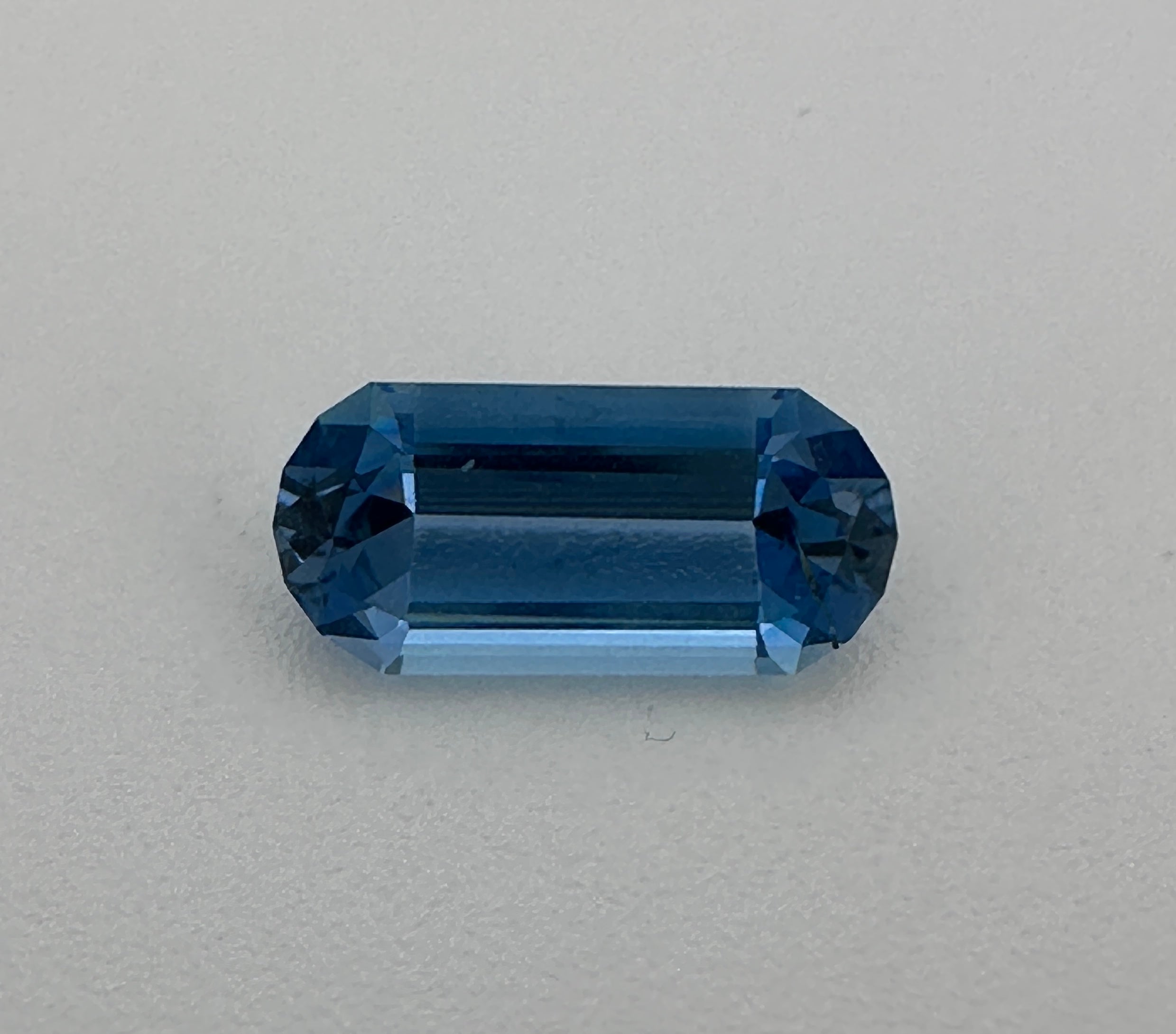
The Ultra Rare aquamarine displays its blue within an elongated silhouette. The table offers a broad view into the material; the faceted terminations punctuate the outline. In motion, bright planes alternate with deeper areas, giving the blue a changing presence without diminishing its strength.
VS clarity allows the geometry to play its part. A bespoke setting can emphasise the elongated shape and protect the tips. Depending on the designer's vision, the stone can form a central axis, a line along the finger or a vertical presence.
The LFG report accompanies this 1.73 ct aquamarine. Ultra Rare's photographs and videos show the actual specimen without AI alteration of its clarity, colour or lustre. The jewellery design begins with this specific material.
From structure to presence
Understanding aquamarine connects several scales: the beryl lattice, iron colour centres, pegmatitic growth and cutting geometry. The strength of the blue belongs to none of these in isolation; it emerges from their combination.
- Hu and Lu, Color Characteristics of Blue to Yellow Beryl from Multiple Origins, Gems & Gemology, 2020. https://www.gia.edu/gems-gemology/spring-2020-color-characteristics-blue-to-yellow-beryl
- GIA, Aquamarine: properties and identity of the variety. https://www.gia.edu/aquamarine
- Shigley and colleagues, Gem-Bearing Pegmatites, Gems & Gemology, 1984. https://www.gia.edu/gems-gemology/summer-1984-pegmatite-shigley
- Hazen, Au and Finger, 1986; beryl structure referenced by AFLOW. https://aflowlib.duke.edu/p/52T5/
- Laboratoire Français de Gemmologie, report 409734 dated 29 April 2024, supplied in the specimen's documentation.
- Ultra Rare Gemstone: origin, VS clarity, photographs and videos of the specimen.