Unheated blue apatite
Mineralogy, the origin of blue and gemmology · Focus on calcium apatites and Madagascar
Apatite's blue colour belongs to a mineral family with varied compositions. This dossier presents structure, growth, light, deposits and identification methods, illustrated by media of the Ultra Rare specimen.
Natural blue, from crystal structure to gem
Unheated blue apatite interests mineralogists, gemmologists and jewellery designers alike. Its colours range from slightly greenish blue to rich blues, sometimes described as “neon” for their vividness. Understanding these hues requires connecting mineral structure, trace elements and lattice defects with the way light is absorbed and transmitted.
“Blue apatite” is a gemmological designation based on colour, not the name of a single mineral species. “Unheated” describes treatment status; it defines neither a particular chemical composition nor an exclusive colour mechanism. This article introduces the family, explores documented blue-colour mechanisms, then examines deposits, inclusions and identification methods.
Calcium apatites and Madagascar production receive particular attention. Photographs from the Ultra Rare collection illustrate the phenomena discussed; examination of an individual specimen appears in section 13.
A calcium phosphate with multiple substitutions
The apatite supergroup brings together minerals related by their crystal architecture. Within it, calcium phosphate apatites form the family discussed here: their general formula Ca₅(PO₄)₃(F,Cl,OH) combines calcium, phosphate tetrahedra and channel anions. Fluorapatite, chlorapatite and hydroxylapatite are distinguished by the respective predominance of fluorine, chlorine or hydroxyl. “Calcium” describes the cation composition; it is not a colour variety. [12]
Hexagonal fluorapatite provides a relevant structural reference model: space group P6₃/m, primitive hexagonal Bravais lattice, class 6/m. With the formula Ca₅(PO₄)₃F, Z = 2 corresponds to 42 atoms per unit cell. With the doubled formula Ca₁₀(PO₄)₆F₂, the same cell has Z = 1; changing the notation does not double the actual atom count. PO₄ tetrahedra, calcium sites and channel anions form an architecture distinct from silicates. [1] [2]
Two families of calcium sites have distinct environments: Ca(I) is surrounded by nine oxygen atoms; Ca(II) comprises six oxygen atoms and one channel anion in the fluorapatite model. This diversity allows numerous substitutions, accompanied where necessary by charge-compensation mechanisms. An ideal formula describes the architecture; it does not replace quantitative analysis of the gem. [2]
Strunz classification places fluorapatite in 8.BN.05; Dana classification places it in 41.8.1.1. The general term apatite remains useful until sufficient chemical characterisation allows the species to be specified. [3] [4]
Fluorapatite — The fluorine end member
Ca₅(PO₄)₃F: fluorine dominates the channel anion site. This is a major reference for blue gem apatite, notably in the Malagasy samples analysed in 2022. Solid solutions also incorporate OH and Cl; the dominant end-member name does not imply perfectly pure composition. The usual hexagonal structure is P6₃/m; monoclinic forms are documented. [1] [6]
Hydroxylapatite — The hydroxyl end member
Ca₅(PO₄)₃OH: hydroxyl groups dominate the channels. This species occurs in varied geological settings and is not limited to biological apatites. The hexagonal reference has nω = 1,651–1,658 and nε = 1,644–1,647, with measured specific gravity of 3,14–3,21. These differ from fluorapatite data: the label “apatite” does not justify assigning a single set of values to both. [16]
Chlorapatite — The chlorine end member
Ca₅(PO₄)₃Cl: chlorine dominates. Rarer than the preceding two end members, it occurs notably in relatively fluorine-poor environments. The ideal end member is monoclinic; some natural compositions also show hexagonal symmetry. Optical behaviour may therefore be biaxial or uniaxial. Chlorapatite is not synonymous with blue jewellery apatite. [17]
Intermediate compositions and carbonate-bearing apatites
Natural crystals can combine F, Cl and OH, together with substitutions at calcium and phosphate sites. “Ca-apatite” encompasses these calcium apatites without choosing an end member. Significant carbonate content describes an additional substitution; it does not automatically define a blue subvariety. Nomenclature must follow analysis and constituent dominance, not an impression of colour. [12]
Unit cell
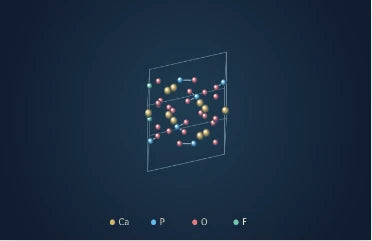
Phosphate tetrahedron

Lattice continuity

Reference structural models: Hughes, Cameron and Crowley (1989), coordinates from the Virtual Museum of the Université du Wisconsin. Colours identify elements; graphic radii are not ionic radii. [15]
From accessory mineral to gem-quality crystal
Apatites occur in numerous geological environments: igneous rocks, pegmatites, carbonatites, certain marbles and skarns, hydrothermal systems and phosphate sedimentary formations. Their presence is not itself an indicator of global mineralogical rarity. Transparent, coloured material suitable for cutting is a highly selective subset. [1]
Igneous rocks, pegmatites and carbonatites
Fluorapatite crystallises as an accessory in many igneous rocks. Syenites, alkaline rocks, carbonatites and granitic pegmatites are important settings; phosphate presence does not guarantee gem quality. Khibiny and Kovdor illustrate concentrations associated with alkaline and carbonatite complexes. [1]
Marbles, skarns and hydrothermal circulation
Crystals are also described in marbles and calcium-rich metamorphic rocks, skarns, Alpine fissures and tin-bearing hydrothermal veins. These settings involve distinct assemblages and fluids; Panasqueira is an example of a crystal locality without implying uniformly blue or facetable material. [1]
Sedimentary formations and residual concentrations
Phosphorites, some phosphate sediments and lateritic residues also belong to fluorapatite geology. A sedimentary, detrital or residual concentration should not be equated with the growth site of a gem crystal. These occurrences concern the mineral; they do not document the Ultra Rare oval's origin. [1]
From crystal to material suitable for cutting
A crystal preserves the effects of its history: growth, environmental changes, trace-element incorporation, fractures and fluid circulation. Turning rough into a gem adds selection for integrity and orientation. The same rough mass can yield very different results depending on fractures, colour distribution and the intended yield.
Documented fluorapatite habits include elongated hexagonal prisms and tabular crystals. The interactive models represent these ideal habits. Cutting orientation links rough shape, fractures, colour distribution and usable volume, contributing to the gem's final appearance. [1]
Elongated prism

Short prism

Tabular habit
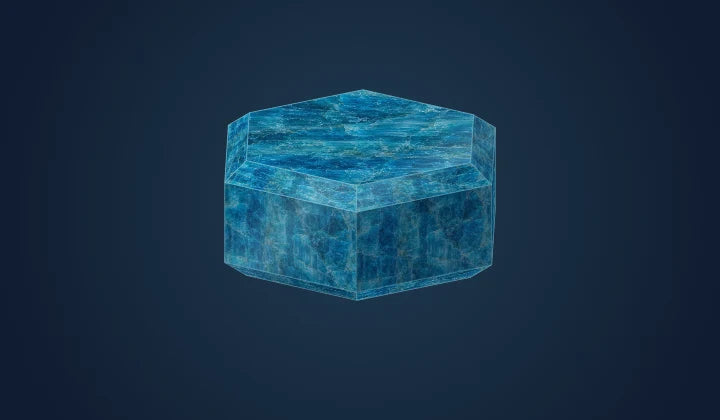


Identifying a bright, delicate material
The properties below use fluorapatite, a common member of gem apatites, as a reference. Values can vary with composition. A refractive-index range includes different materials: a stone's birefringence is determined on that stone, not by subtracting the extremes of a general range.
Rigorous identification combines several observations. Refractive index, optical behaviour and specific gravity provide complementary reference points; spectroscopy compares them with a mineral signature. Blue intensity alone does not identify apatite.
| Property | Reference information [1] |
|---|---|
| Refractive indices | nω 1,631–1,650 ; nε 1,627–1,646 |
| Birefringence | Approximately 0,004 for the fluorapatite model |
| Optic character and sign | Uniaxial negative · hexagonal model |
| 2V angle | Not applicable to the uniaxial model |
| Pleochroism | Variable; weak to strong depending on material and orientation |
| Dispersion | Not documented in the selected sources |
| Specific gravity | 3,10–3,25 |
| Hardness | 5 on the Mohs scale |
| Cleavage / parting | Poor cleavage on {0001} and {10-10} |
| Fracture / tenacity | Conchoidal to uneven; brittle |
| Lustre | Vitreous to subresinous |
The origin of blue, species by species
Blue is an optical response: part of the visible spectrum is absorbed while blue wavelengths are transmitted more strongly. Major composition defines the species; trace elements, their valence and sites, and lattice defects determine the absorbing centres. F, Cl and OH are therefore not three blue chromophores in their own right.
Fluorapatite — Manganese, rare earth elements and colour centres
Pentavalent manganese. The foundational study by Johnson, Prener and Kingsley (1963) compares the optical signatures of natural blue apatites with those of compounds containing MnO₄³⁻. This group, in which Mn⁵⁺ occupies a tetrahedral environment, can replace PO₄³⁻ without changing the group's overall charge. The resulting absorption favours a blue appearance. This mechanism is established for the studied materials; Mn²⁺ at a calcium site has different electronic behaviour. [13]
Malagasy greenish blues. For the fluorapatites studied in 2022, the authors connect colour with Ce, Nd and structural distortions, with pronounced orange-red absorption. This interpretation rests on their sampling and analyses and is distinct from universal attribution to manganese. Cerium and neodymium must not be confused: their spectral contributions and electronic states differ. [6]
Defect-related centres. Experimental work on Malagasy green apatites heated under reducing conditions associates green with a Ce³⁺–SiO₃⁻ centre and blue with SO₃⁻. This is a transformation studied under treatment: it establishes neither that all blue apatites are heated nor that every unheated crystal has the same colour centre. [7]
Hydroxylapatite — An experimentally demonstrated manganese mechanism
Manganese-bearing hydroxylapatites become blue after sintering in an oxidising atmosphere. Electron paramagnetic resonance and structural analysis link this transformation to oxidation of Mn²⁺ to Mn⁵⁺ and formation of MnO₄³⁻ groups at phosphate sites. This model demonstrates that the hydroxyl end member can host a blue manganese centre. However, it concerns material subjected to high temperature; it does not prove a supply of natural unheated blue hydroxylapatite gems. [18]
Chlorapatite — Separating observed colour from chromophore assignment
Synthetic chlorapatite single crystals enriched in rare earth elements and strontium have been produced with a light blue tint. Their chemistry and structure are characterised in the study by Klemme and colleagues (2013), but this observation does not assign the hue to one ion. Natural chlorapatites described in the Handbook include greenish yellow, greenish grey and pinkish white tones. These references do not establish a universal natural unheated-blue mechanism specific to the chlorine end member. [17] [19]
Intermediate Ca-apatites — Composition modifies the colour centre
Substitutions alter interatomic distances, site environments and charge-compensation conditions. Studies of apatite-structured compounds containing Mn⁵⁺ show that lattice variations can shift the turquoise hue. This structure–colour relationship explains why a chemical family does not impose one colour; it does not remove the need to analyse a natural gem before assigning its mechanism. [14]
Neon blue, blue-green and cat's-eye — Gemmological expressions
“Neon” describes perceived saturation and vividness, without naming a species or proving fluorescence. Blue-green corresponds to a different transmission balance. Cat's-eye is an organised reflection from oriented structures, brought out by a cabochon cut; a Brazilian neon blue cat's-eye apatite of 12.50 ct illustrates this coexistence of colour and chatoyancy. [5]
Pleochroism and fluorescence
Pleochroism reflects orientation-dependent absorption. Fluorescence is emission under excitation; its colour need not match that seen in white light. In the Malagasy study of 2022, specimens were inert to long- and short-wave UV. This result applies to that sample set, while apatite fluorescence remains variable. [1] [6]
Growth, fractures and internal landscapes
An inclusion may record crystal growth or later history. Its morphology guides examination, but a needle-like shape is not a chemical identification. Microscopy examines relief, orientation and relationships with fractures; targeted Raman analysis may be needed to name an included crystal. [8]
Gemmological studies of apatite describe growth tubes, particles, small unidentified crystals and reflective fissures. The educational plate distinguishes these visual families; it supplies neither global statistical frequency nor automatic Malagasy origin. [9]
An example published by GIA in 2026 describes goethite sprays in a surface-reaching fracture in blue-green apatite. Their formation is interpreted as later than the host crystal, through circulation and subsequent precipitation of iron-bearing material. This example shows why inclusion history can differ from that of the gem. [10]
Collection illustration. The photomicrograph of Ultra Rare's 6.612 ct apatite shows lines and contrast zones within blue material. It accompanies the educational diagrams without assigning mineral identities to the photographed inclusions. For the house, this internal landscape evokes the blue spaces of Franco-Chinese painter ZAO WU KI.
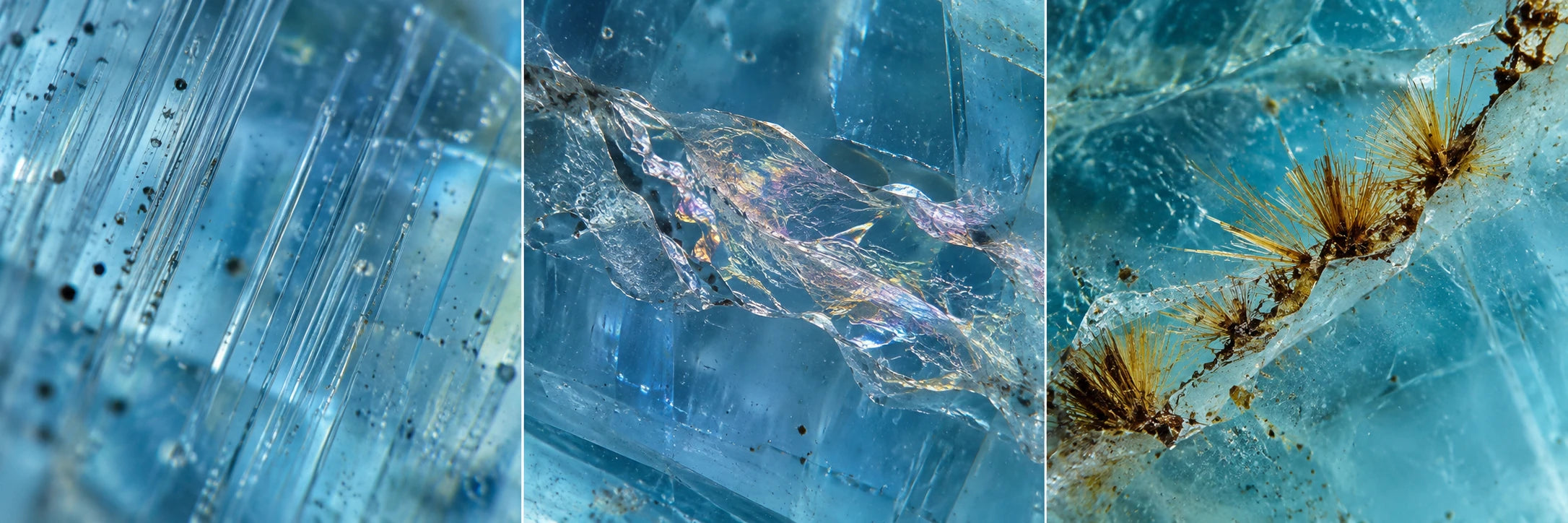
Elongated structures and pinpoint inclusions.
Reflections from an internal discontinuity.
Published example within a fracture; not a feature found in every specimen.
Computer-generated educational illustrations; interpretative morphologies without a measurement scale. They do not represent the Ultra Rare specimen. References: [9] and [10].
A worldwide mineral, selected gem sources
The atlas distinguishes two documentary levels: countries where blue gem apatites are described, and a broader set of gemmological sources or collectible crystals. Markers represent published occurrences, without implying current activity, identical colour or unheated status for all production.
Apatite — Occurrence atlas
Relief, vegetation and reference markers
World

Madagascar

● Documented gem-quality blue: Brazil and Madagascar. ● Other gemmological sources or crystals: markers 03 to 12.
Natural Earth II base map: idealised vegetation cover, relief and hydrography, public domain. Malagasy markers are regional; Androy indicates the specimen's origin according to the Ultra Rare dossier. Click each map to enlarge it.
Documented gem-quality blues
01 · Madagascar. Studied blue-green fluorapatites; several apatite districts recorded. Geological detail in section 08. [6] [11]
02 · Brazil. Neon blue cat's-eye apatite published by GIA; various Brazilian gemmological localities, notably Bahia and Minas Gerais. [5] [20]
Other gemmological sources
03 · Myanmar.
Mogok region.
04 · Sri Lanka.
Notably Ratnapura and Matale.
05 · India.
Karnataka, Odisha and Tamil Nadu.
06 · Kenya.
Embu region.
07 · Russia.
Slyudyanka region, Lake Baikal. [20]
Crystals and mineralogical settings
08 · Canada.
Ontario and Québec.
09 · United States.
Maine.
10 · Mexico.
Cerro de Mercado, Durango.
11 · Pakistan. Chumar Bakhoor, Nagar.
12 · Portugal. Panasqueira. [1]
These occurrences are not all sources of intense unheated blue.
Madagascar: diverse occurrences and intense blues
GIA gemmological inventories list several Malagasy apatite localities, notably in the north around Ambilobe, Ankarafa, Daraina, Manambato and Milanoa, as well as Mitsinjo in the former Toliara province. This diversity prevents “Madagascar” from being treated as a single deposit. [11]
Madagascar's greenish blue apatites have been the subject of a dedicated gemmological and mineralogical study. This origin is of particular interest for the vivid colours observed and the opportunity to examine composition alongside optical properties. Results from analysed samples must be distinguished from the full diversity of the island's production. [6]
Describing Madagascar as a leading origin for sought-after blues does not imply a single deposit. Gem assessment combines hue, saturation, transparency, colour distribution and cut quality. An aesthetic assessment of the best specimens is not a universal geological ranking.
Madagascar · Geology and occurrences
Enlargement of the national base map · Northern Madagascar. Regional markers, without mine boundaries.
Location key
Ambilobe Northern gemmological locality.
Daraina · Milanoa North-eastern markers; regional halos.
Androy Regional origin of the Ultra Rare specimen.
Geological base map Basement domains, sedimentary cover and volcanism; generalised boundaries.
Unheated: meaning and gemmological documentation
Heating is a treatment. Experimental studies show that it can alter the colour and luminescence of some apatites; its effect depends on the material and conditions applied. These documented transformations do not mean that every intense blue results from human intervention. [7]
Unheated blue apatite is sought after for colour preserved without thermal treatment. Gemmological examination looks for treatment indicators accessible to the methods used. The conclusion “no indication of treatment” includes no indication of heating within that analytical scope; it must be reproduced faithfully together with any laboratory notes.
Understanding colour mechanisms and determining treatment history are distinct processes. Demonstrating that a chromophore produces blue does not alone establish every intervention a gem may have undergone. Conversely, no indication of heating does not require the laboratory to have identified its exact chromophore.
Rough traceability, cutting information and retained documents complement examination. Bringing them together allows precise presentation of a stone and its treatment status, without treating a colour impression as evidence.
The rarity of a combination of qualities
Occurrence
Apatite is widespread in rocks, but its mineralogical presence does not measure the availability of vivid blue transparent crystals. Madagascar and Brazil are documented sources of blue gems; the atlas distinguishes this production from other occurrences, whose colour, quality and extraction activity vary. Fractures, inclusions, colour distribution and cutting losses progressively reduce usable volume.
Ultra Rare commercial estimate. According to the house's assessment based on availability it observes on the market, gem-quality blue apatite represents less than 1 % of gem apatite production, and approximately 80 % of this blue production is heated to obtain vivid blue. These proportions are presented as an Ultra Rare estimate, not global statistics established by the cited publications.
Rarity within rarity
Eye clean, unheated blue over one carat
Selection becomes particularly narrow when a stone exceeds one carat, retains attractive blue without heating and shows no unaided-eye inclusions at 20–30 cm under the Ultra Rare grading system. The weight threshold adds to clarity and treatment status: a transparent crystal is not automatically eye clean, and clear rough does not guarantee a gem over one carat after fragile zones are removed.
Intense blue, transparent and unheated
Another remarkable combination brings together strong saturation, sufficient light transmission and colour preserved without heating. This can occur in an included stone: transparency describes light transmission, while clarity describes inclusions. The challenge is to retain strong, clearly expressed blue without dark zones, fractures or cutting depth suppressing light. These criteria allow comparison without confusing colour intensity with absence of inclusions.
Stones combining both sets of qualities meet the most demanding level of selection. The Ultra Rare 6.612 ct apatite , transparent and included, illustrates the second combination through its intense blue; it is not presented as eye clean. No rarity multiplier relative to diamond is derived from these criteria.
Identifying apatite and specifying its composition
Identification rests on converging observations: refractive indices, optical behaviour, specific gravity, inclusions and spectroscopic signatures. Blue colour, however vivid, cannot identify apatite alone. Conclusions become stronger when several independent methods agree.
Recognition of the group sometimes precedes species determination. Distinguishing fluorapatite, chlorapatite and hydroxylapatite end members requires characterisation of composition and the relevant anions. “Calcium apatite” remains broader than an identification of fluorapatite. [12]
Microanalysis provides information on constituents and trace elements; vibrational methods add structural information. Detection limits and the ability to measure light elements vary by method. A list of techniques available in a laboratory does not mean that all were applied to every stone.
Mineral identification, treatment investigation and geographical origin determination are different conclusions. Precise provenance requires appropriate evidence and comparative references; it cannot be inferred from the mineral name alone. [8]
Connecting an observation to the method that produces it
UV-Vis-NIR. Selective absorption provides information about optically active centres. For fractional transmission T, absorbance is written A = −log₁₀(T) under the stated measurement conditions. Strong absorption in a visible region reduces its contribution to transmitted light; colour interpretation concerns the full spectral response, not an isolated band.
Raman. Lattice and phosphate-group vibrations provide a mineral signature, while a localised measurement can help identify an inclusion. FTIR provides information on other vibrational modes and certain substitutions or species present. PL observes emission under excitation. These methods are complementary; their results depend on protocol and sample.
An elemental composition and an absorption band answer different questions. A trace element's presence does not establish its oxidation state or exclusive responsibility for colour. Published interpretations must be read in the context of their material and protocol, particularly for blue apatite. [6] [7]
Comparing spectra requires knowledge of orientation, traversed thickness, any polarisation and instrument conditions. Transmission and absorbance curves cannot be directly superimposed. Studies of apatite blue illustrate the need to compare an optical signature with compositional analyses. [6] [7] [13]
The blue oval, 6.612 carats
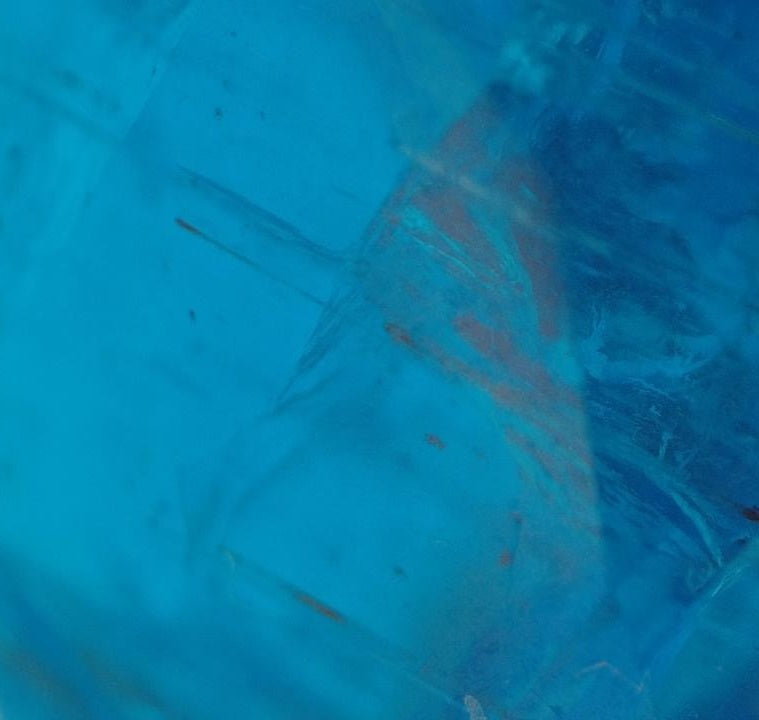
The Ultra Rare 6.612 ct apatite measures 12.9 × 10.3 × 6.8 mm. Its oval outline and vivid blue give the jewellery designer a clearly defined field of colour. The photographs show both its transparency and inclusions, without retouching the gemstone.
Bellerophon GemLab testing dated 24 October 2025 identifies item T8934, with printed weight 6.612 ct, as “Natural Ca - APATITE”. It states “No indications of any treatment”: no indication of treatment, including heating, within the scope of examination. The note “Colour origin is currently undeterminable” remains attached to this document; it is not an indication of heating. The stone's specific chromophore mechanism is not detailed. The specimen comes from the Androy region of Madagascar according to the Ultra Rare dossier.
Apatite's moderate hardness and fragility favour protected use. Selecting a brooch or pin is a design choice here: the jeweller must examine the actual stone, particularly its inclusions and edges, before defining the setting's supports and stresses.

Connecting mineral knowledge with gem observation
Unheated blue apatites bring together chemical diversity, colour mechanisms, geological history and gemmological selection. Understanding them rests on scientific results read in context. Documented blue-colour mechanisms provide an explanation of colour, while individual examination establishes what can be concluded for each gem.
Collection photographs give tangible expression to this knowledge. They illustrate colour, transparency and internal landscapes without replacing analyses. Theoretical models and diagrams remain identified; general species data and specimen-specific conclusions are presented separately.
Main sources and further reading
- Fluorapatite — Handbook of Mineralogy
- First Principles NMR Study of Fluorapatite under Pressure
- Fluorapatite classification — Musée national d’histoire naturelle de Sofia
- Fluorapatite in the Dana classification — Webmineral
- Tao Hsu, Blue Cat’s-Eye Apatite, GIA, 2013
- Gemological and Mineralogical Studies of Greenish Blue Apatite in Madagascar, 2022
- Effect of heat treatment on the luminescence properties of natural apatite, 2018
- GIA — Analytical Methods in Geographic Origin Determination, 2019
- The Journal of Gemmology, 34(8), 2015 — apatite and inclusions
- Damba and Koivula, Goethite Sprays in Apatite, GIA, 2026
- GIA — Gem localities, 2010
- Pasero et al., Nomenclature of the apatite supergroup minerals, 2010
- Johnson, Prener and Kingsley, Apatite: Origin of Blue Color, 1963
- Hughes, Cameron and Crowley (1989) — Fluorapatite coordinates, Université du Wisconsin
- Intense turquoise colors of apatite-type compounds with Mn5+ in tetrahedral coordination
- Hydroxylapatite — Handbook of Mineralogy
- Chlorapatite — Handbook of Mineralogy
- Relationship between the colour change of hydroxyapatite and the trace element manganese
- Klemme et al. (2013) — Synthesis of trace element bearing single crystals of chlorapatite
- Gems & Gemology, Winter 2000 — Directory of gemmological localities
- Natural Earth — World geographical base map, public domain